Grain-Free or Grain-Inclusive? Choosing Without the Hype
PawPicked is reader-supported: we may earn a commission from links on this page.
Most dogs digest cooked grains perfectly well, and there is no general reason to avoid them. Grain-free food is a legitimate choice for some dogs and owners, but it is not a healthier default, and the idea that grains are fillers that harm dogs is far more confident than the evidence behind it.
That is the straight answer. The rest of this guide explains why the market looks the way it does, what grain-free recipes use instead, and how to decide for your own dog, using three Amazon.co.uk listings as examples. None of the products were tested by us, and every benefit mentioned is the maker's claim.
Why grain-free exists
Grain-free recipes took off as owners looked for simpler or more "natural" food, and as some dogs seemed to do better after a switch. Sometimes that is real: a dog with a confirmed sensitivity to a particular ingredient may do better on a recipe that leaves it out. But a food change can also coincide with a change in protein, fat or fibre, so the grain is not necessarily the reason a dog improves.
Food allergy in dogs, according to veterinary sources, more commonly involves animal proteins such as beef, dairy or chicken than grains. Grain allergy exists but is less often the culprit. Our guide to what hypoallergenic really means covers how a real allergy is diagnosed.
What replaces the grain
Kibble needs a starch to hold together, so grain-free recipes swap in other sources: potato, sweet potato, peas, lentils or tapioca. The listings show this plainly.
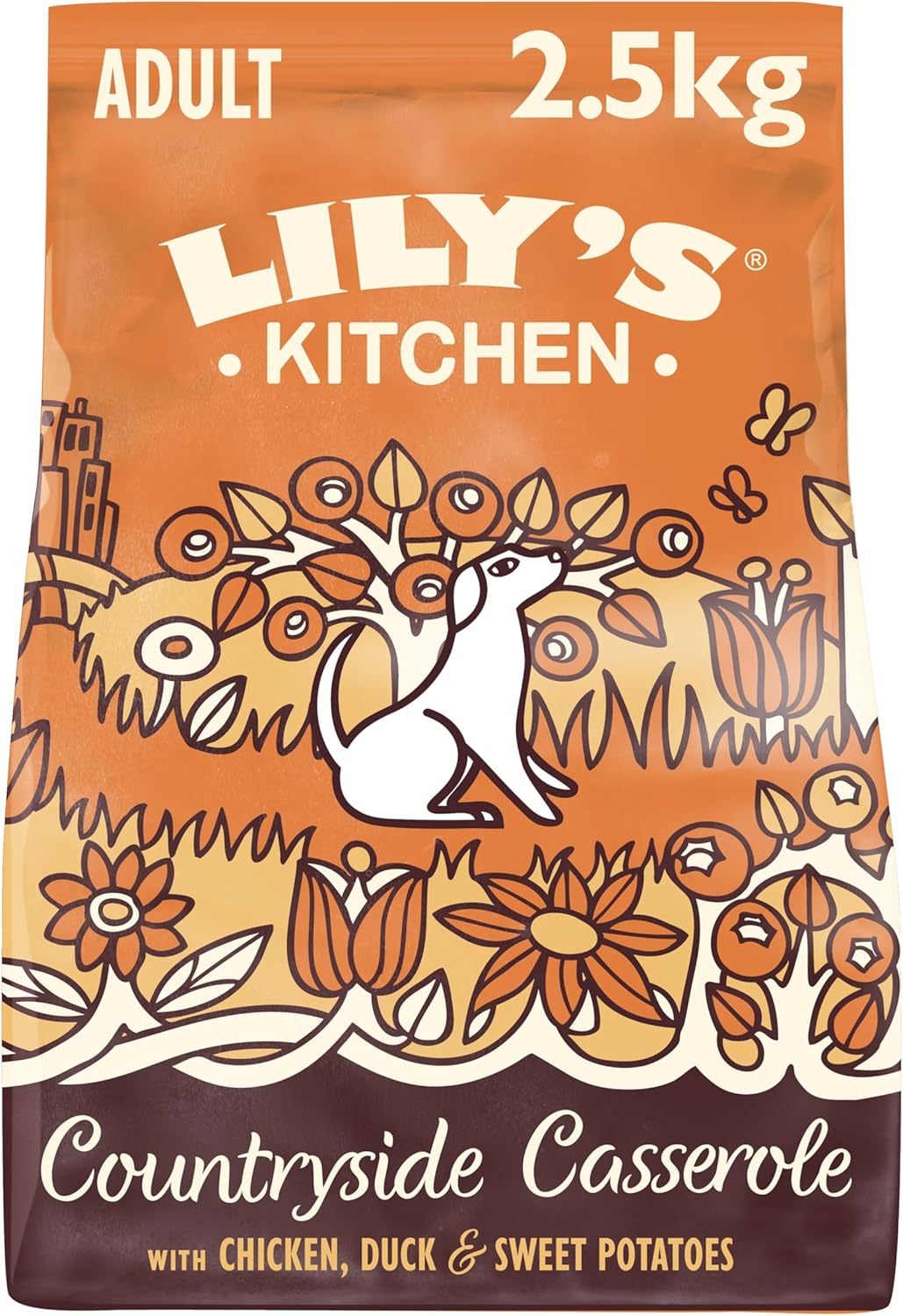
The Lily's Kitchen Adult Chicken & Duck Grain-Free recipe gives sweet potatoes at 29 per cent, whole peas at 6.5 per cent, then lentils, pea protein and potato protein, alongside 31 per cent fresh chicken, 8 per cent freshly prepared duck and 3 per cent chicken liver. The listing adds that it is made in a factory that handles grains, so traces may be present. It also states "no meat meal".
The James Wellbeloved Adult Grain-Free Turkey listing leads with dried turkey protein at 24.5 per cent and dried potatoes at 24.4 per cent, plus pea starch, tomato pomace and dried peas. The listing says it excludes beef, pork, soya, eggs, dairy and wheat, which is an exclusion list rather than a grain argument.
In other words, the grain has been replaced by something else, not removed to leave pure meat. Whether the swap is an improvement depends on the dog.
The grain-inclusive side
The Burns Original Adult & Senior Chicken & Brown Rice recipe shows the other design. Brown rice is 67 per cent of the ingredients, dried chicken is 20 per cent, followed by oats, peas, chicken oil, sunflower oil and seaweed. The listing describes it as a limited-ingredient recipe with wholegrains for easy digestion, which is the maker's description.
Here the grain is the base, not a villain. The main drawbacks of this approach are the opposite of the grain-free ones: it is no use if your dog reacts to the cereals it contains, and brown rice at that proportion makes this a carbohydrate-led food, which some owners would rather avoid.
The heart question
You may have seen warnings linking grain-free food to a heart condition in dogs called dilated cardiomyopathy. Researchers, mostly in the United States, have examined whether diets high in peas, lentils and potatoes might be involved in some cases. The evidence is not settled, no cause has been proven, and the picture is complicated by factors such as breed and genetics. We cannot resolve it here.
What is reasonable to say is that this is a question to raise with your vet, particularly if your dog is a breed prone to heart disease or is already on a grain-free, legume-rich food. It is not a reason to panic, and it is not a reason to dismiss the question either.
How to decide
- No known problem. A complete, well-made grain-inclusive food is a safe default for most dogs, and it is the simplest place to start.
- Confirmed or suspected ingredient sensitivity. Work with your vet; the ingredient to avoid may not be a grain at all.
- You prefer grain-free. That is a fair choice. Choose a complete food from a reputable maker, read the whole ingredient list, and discuss it at your next check-up.
- Your dog is doing well. If your dog is healthy, at a good weight and with good stools on its food, there is rarely a strong case for changing for the sake of a label.
What tends to go wrong
Treating "grain-free" as shorthand for "better" is the main one. Others include switching foods suddenly, which upsets stomachs whatever the recipe; assuming a short ingredient list means a nutritionally better one; and judging by the front of the bag rather than the list on the back. Our guide to reading a dog food label is a good place to build the habit.
Buying size matters too. The Lily's Kitchen listing here is for 2.5kg, James Wellbeloved for 10kg and Burns for 6kg, so work out how long a bag will last for your dog before buying, and check the current price on Amazon for the real cost per day.
When to see a vet
Persistent itching, repeated ear infections, ongoing loose stools, weight loss, tiring easily or coughing are all reasons to book an appointment rather than change the food and hope. This guide is general information, not veterinary advice, and none of the foods mentioned here are treatments. If you are thinking of moving a dog with a health condition to or from a grain-free diet, ask your vet first.
Products in this article


Affiliate links — we may earn a small commission at no extra cost to you.