Orijen Original vs Six Fish: Picking the Right Recipe
PawPicked is reader-supported: we may earn a commission from links on this page.
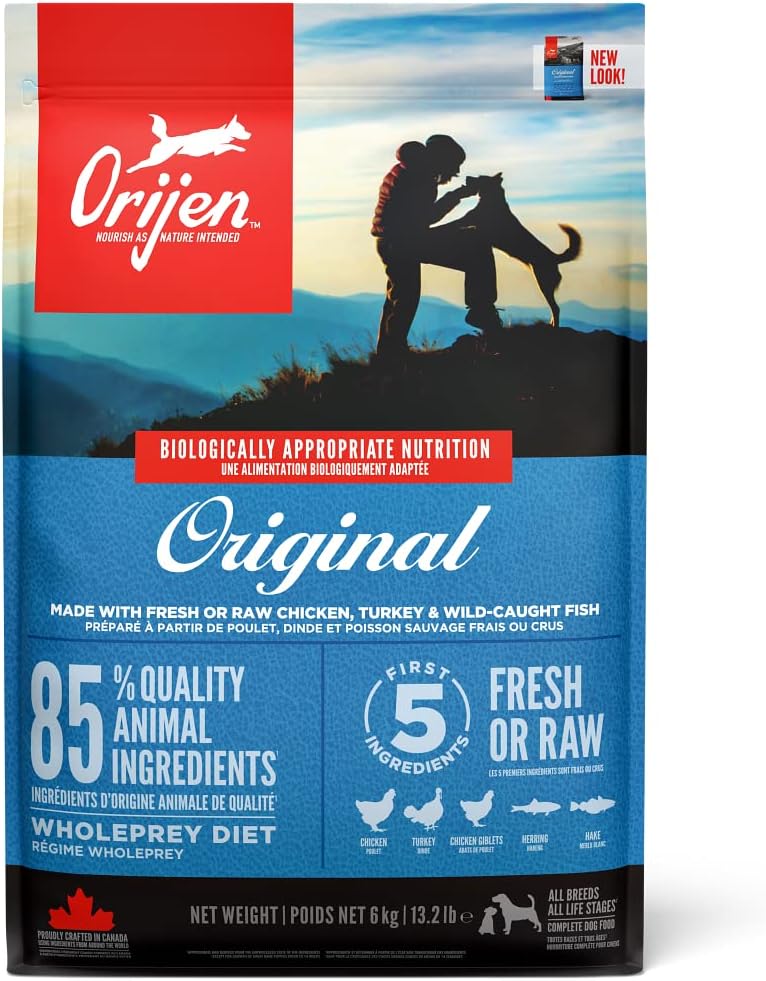
The real decision between Orijen Original Adult and Orijen Six Fish is not about brand quality, since both come from the same maker. It is about the protein: poultry plus fish in one bag, or fish and nothing else. Both are dry foods whose listed ingredients rely on lentils, peas and chickpeas rather than cereal grains, so almost everything else follows from that one choice.
The differences on paper
| Original Adult | Six Fish | |
|---|---|---|
| Pack size on the listing | 6 kg | 11.4 kg |
| First-listed ingredients | Boneless chicken, chicken meal, chicken liver, whole herring, boneless turkey | Whole salmon, whole herring, salmon meal, herring meal, pollock meal |
| Poultry in the ingredient list | Chicken and turkey, plus whole eggs | None listed |
| Fish in the ingredient list | Herring, walleye, salmon | Salmon, herring, pollock, flounder, walleye, northern pike, lake whitefish |
| Headline claim | "Meat (80%)" in the bullet points | Fresh, wild-caught Canadian fish |
| Storage note | None on the listing | Use within 4 weeks of opening |
| Amazon.co.uk rating | 4.7 out of 5 from 564 ratings | 4.7 out of 5 from 1,078 ratings |
Ratings are as shown at the time of writing and say nothing about how a particular dog will do on either food.
Poultry and fish, or fish alone
Original is the broader recipe. It lists chicken, turkey, whole eggs and several fish, which makes it a mixed-protein food. For a dog that eats poultry without trouble, that variety is the selling point. For a dog that has reacted badly to chicken, it is a poor fit: chicken appears in several forms, including meal, liver, heart, cartilage and liver oil.
Six Fish removes the poultry entirely. The listing describes it as free of rendered poultry meals, and the ingredient list backs that up, with the protein coming from salmon, herring, pollock and a handful of freshwater species. Owners who have been told by a vet to avoid poultry sometimes look at foods like this. The caveat is that fish is itself a recognised allergen, and the listing flags it as such. It is a different set of ingredients, not a guaranteed safe one.
The Six Fish listing also mentions a sensitive stomach under recommended uses. Treat that as a maker's claim. No feeding trial or study is offered, and a food built around rich fish and oils will not suit every dog with a delicate digestion.
What the maker says about both
The listings use similar language. Original is described as biologically appropriate, with free-run chicken and turkey, wild-caught fish and nest-laid eggs, and the Six Fish description talks about six wild-caught Canadian fish. Both ingredient lists also finish with the same run of fruit, vegetables and herbs, and both include a probiotic organism, Enterococcus faecium. These are the maker's descriptions of its philosophy. The listings do not offer independent evidence that a dog does better on either recipe.
Practical points that decide it
Bag size and freshness. The Six Fish bag on the listing is nearly twice the size of the Original one, and it carries an instruction to use the food within four weeks of opening. A small dog will not get through 11.4 kg in that time. The listing also contradicts itself on weight, since the description text mentions 13 kg, so check the size before ordering. The Original listing is the easier one for a medium or small dog to finish.
Cost per day. Divide the pack price by the number of days a bag lasts, using the feeding guidance on the packaging, and compare that figure rather than the bag prices. Check the current price on Amazon, because different pack sizes make a price-per-bag comparison misleading here.
Richness and legumes. Both recipes are legume-heavy and protein-dense. Most vets suggest that dogs with certain health conditions, or dogs that are overweight, should be moved onto a rich food only with advice. There has also been ongoing research into a possible link between some grain-free, legume-rich diets and heart problems in dogs. The evidence is unsettled, but it is a fair question to raise with your vet, and our piece on grain-free versus grain-inclusive food covers it in more depth.
Smell and appetite. Fish-based kibble tends to smell stronger in the bag and the kitchen. Some dogs love that, and some households do not.
Switching between the two
Moving from one to the other changes the entire protein source, so go slowly. Most guidance suggests mixing the new food in with the old over seven to ten days or longer, increasing the share each day, and holding back if stools turn loose. Our guide to switching your dog's food sets out a day-by-day pattern. If a dog has persistent diarrhoea, vomiting or weight loss on either recipe, that is a vet visit, not a reason to try a third bag.
Which one suits which owner
Choose Original if your dog does well on chicken and turkey, you want a mixed-protein recipe, and you would rather buy a bag of a size a medium or smaller dog can finish. The detail behind it is in our Orijen Original review.
Choose Six Fish if poultry is the thing you need to avoid, your dog is happy eating fish, and you have the storage and the appetite in the house to work through a large bag within a month of opening. The Six Fish review goes through the ingredient list line by line.
Choose neither if your dog needs a diet managed by a vet. Both are standard adult foods and neither is a substitute for a supervised elimination plan.
Products in this article

Affiliate links — we may earn a small commission at no extra cost to you.