Probiotics vs Prebiotics for Dogs: What's the Difference?
PawPicked is reader-supported: we may earn a commission from links on this page.
A probiotic is a live microorganism, usually a bacterium, that is given in the hope it will settle in the gut and help. A prebiotic is not alive at all: it is a type of fibre that gut bacteria can feed on. Put them together in one product and you get what labels often call a pre and probiotic, or sometimes a synbiotic. That is the whole distinction. The rest of this guide is about how to spot each on a label and what to be sceptical about.
Reading the two on a real label
The easiest way to learn the difference is to look at ingredient panels. Two Amazon.co.uk listings make good examples.
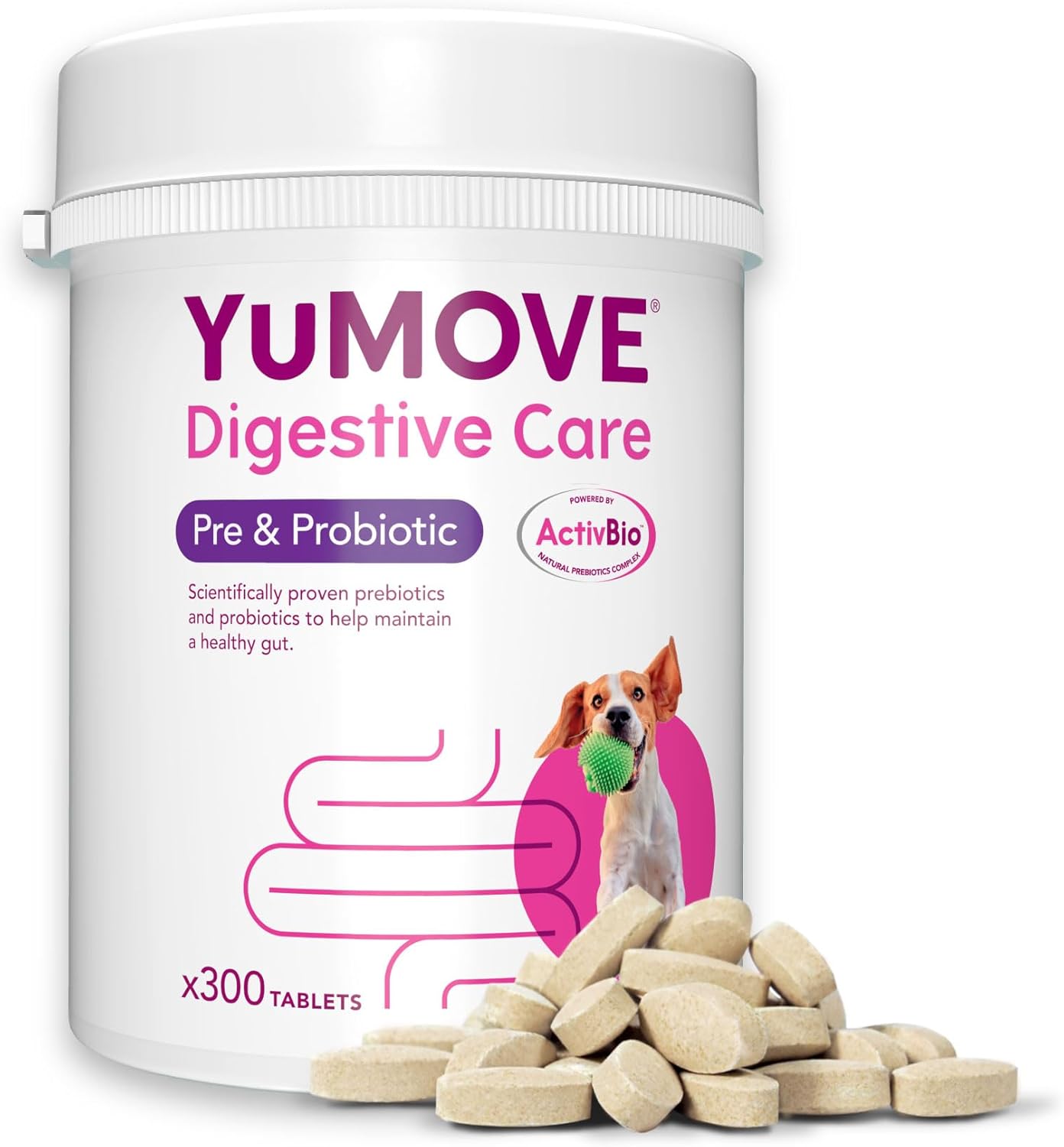
YuMOVE Digestive Care says each tablet provides 200 million of the probiotic E. faecium plus a prebiotic complex made of MOS, scFOS and beta-glucans. The probiotic is the live bacteria. The prebiotic part is three fibre-type ingredients:
- FOS and scFOS stand for fructo-oligosaccharides and short-chain fructo-oligosaccharides, which are sugars bacteria can ferment.
- MOS is mannan-oligosaccharides, and the listing says it comes from yeast extracts.
- Beta-glucans are another type of soluble fibre, also yeast-derived on this label.
Pooch & Mutt Bionic Biotic uses a different probiotic organism, Bacillus velezensis DSM 15544, with chicory root powder listed as a source of fructo-oligosaccharides at 15%. So the two products pair a probiotic with a prebiotic, but the bacteria are different species. Not every probiotic is the same, and the strain on the label matters more than the word "probiotic".
What the numbers mean
Probiotic labels give a count in CFU, which stands for colony-forming units, meaning the number of live bacteria that could grow into a colony. Labels may express it per tablet, per sachet, per gram or per kilogram, as the listings above do. Those units cannot be compared directly with one another. A bigger CFU number does not by itself mean a better product, and nothing on these listings shows that a given count works for a given dog.
Prebiotics are usually given as a percentage of the composition, as in "FOS 15%". That tells you how much of the formula is fibre, but it does not tell you how much a dog actually receives per day unless you also know the serving.
Why companies pair them
The reasoning offered is that the probiotic needs something to feed on while it is in the gut, so a prebiotic fibre is included alongside. That is the maker's argument, and it is a reasonable one, but how well it works in a particular dog is not something a label shows. These are supplements, not medicines.
Mistakes worth avoiding
Treating the words as a guarantee. "Pre and probiotic" on the front of a pack says what category it is, not what it will do.
Expecting an overnight result. Many vets advise giving gut products time rather than judging them after a single day, and if nothing seems to change, speak to your vet rather than adding something else.
Changing everything at once. If you start a supplement the same week as a new food, you will not know which did what. Our guide to switching your dog's food gradually explains the slower approach.
Using human products. Some human supplements and foods contain sweeteners such as xylitol, which is toxic to dogs, or other ingredients not meant for them. Use products made for dogs.
Forgetting the rest of the formula. Probiotics and prebiotics sit alongside other ingredients. The Bionic Biotic listing, for example, also includes fish oil, yeast, maize and a list of added vitamins and minerals, and the YuMOVE tablet includes yeast-derived ingredients. If your dog is sensitive to something, check the full panel, not only the headline probiotic.
Assuming a high-fibre formula is harmless. Fibre can change stools and cause wind in some dogs, especially if the amount changes suddenly. Follow the serving on the pack and ask your vet if you are unsure.
When to see a vet
A probiotic is not a substitute for finding out why a dog has a digestive problem. See a vet if diarrhoea lasts more than a day or two, if there is blood, if the dog is vomiting, lethargic or off its food, or if the dog is a puppy or an older animal, as both can become unwell quickly. Our guide on what to do at home and when to call the vet sets out the warning signs, and when a dog might benefit from a probiotic looks at the situations where trying one is reasonable.
This guide is general information, not veterinary advice.
The short version
If a label says probiotic, look for a named bacterial species and strain, and treat the count as one piece of information, not a score. If it says prebiotic, look for named fibres such as FOS, MOS or beta-glucans and remember they are food for bacteria, not bacteria themselves. If it says both, you have a pre and probiotic. Whichever you pick, give it as directed and let your vet decide when a digestive problem needs more than a supplement.
Products in this article

Affiliate links — we may earn a small commission at no extra cost to you.