When Might Your Dog Need a Probiotic?
PawPicked is reader-supported: we may earn a commission from links on this page.
Short answer: most healthy dogs on a settled diet don't need a probiotic, and the cases where one is worth considering tend to be short and specific. A change of food, a stressful week or a course of antibiotics are the usual triggers. Even then, a supplement is a support for digestion, not a fix for a problem that needs a vet.
Four situations where owners reach for one
A change of food. Moving to a new diet can loosen stools for a few days. A gradual switch over a week or two does most of the work, and we cover the routine in our guide to switching food without an upset stomach. Some owners add a probiotic or prebiotic over the same period. The evidence that this makes a noticeable difference is limited, so treat it as optional rather than essential.
Stress and disruption. Kennels, travel, visitors, a house move and fireworks week all get blamed for upset tummies. Gut and stress are linked in dogs as they are in people, which is partly why these products are sold for "sensitive digestion". That is marketing language, though, not proof. The sensible first move is reducing the stress where you can.
After antibiotics, on vet advice only. Antibiotics act on gut bacteria as well as the infection they were prescribed for, and some vets suggest a probiotic alongside or after a course. That decision belongs to your vet, who knows the drug and the timing. Don't start one on your own initiative, and never change or stop the antibiotics because the stools look better or worse.
Occasional loose stools in an otherwise bright dog. This is where the paste products are positioned. If it goes beyond a day or two, the answer is a phone call rather than a different supplement. Our page on what to do about dog diarrhoea covers what you can safely do at home.
What the three listed products actually are
The three products we looked at are quite different in format, which matters more than the brand name when you have to give them every day.
| YuMOVE Digestive Care | Pooch & Mutt Bionic Biotic | Protexin Pro-Kolin Advanced | |
|---|---|---|---|
| Format | Tablets (300 count) | Powder, 200g | Paste, 30ml syringe |
| Live bacteria named | Enterococcus faecium | Bacillus velezensis | Enterococcus |
| Prebiotics named | MOS, scFOS, beta-glucans | Chicory root (FOS) | Preplex, pectin |
| How it is given | By weight, 1 to 4 tablets | Sprinkled over meals | Syringe with dosage wheel |
| Notable extras | None listed | Fish oil, vitamins | Psyllium, kaolin, montmorillonite, taurine |
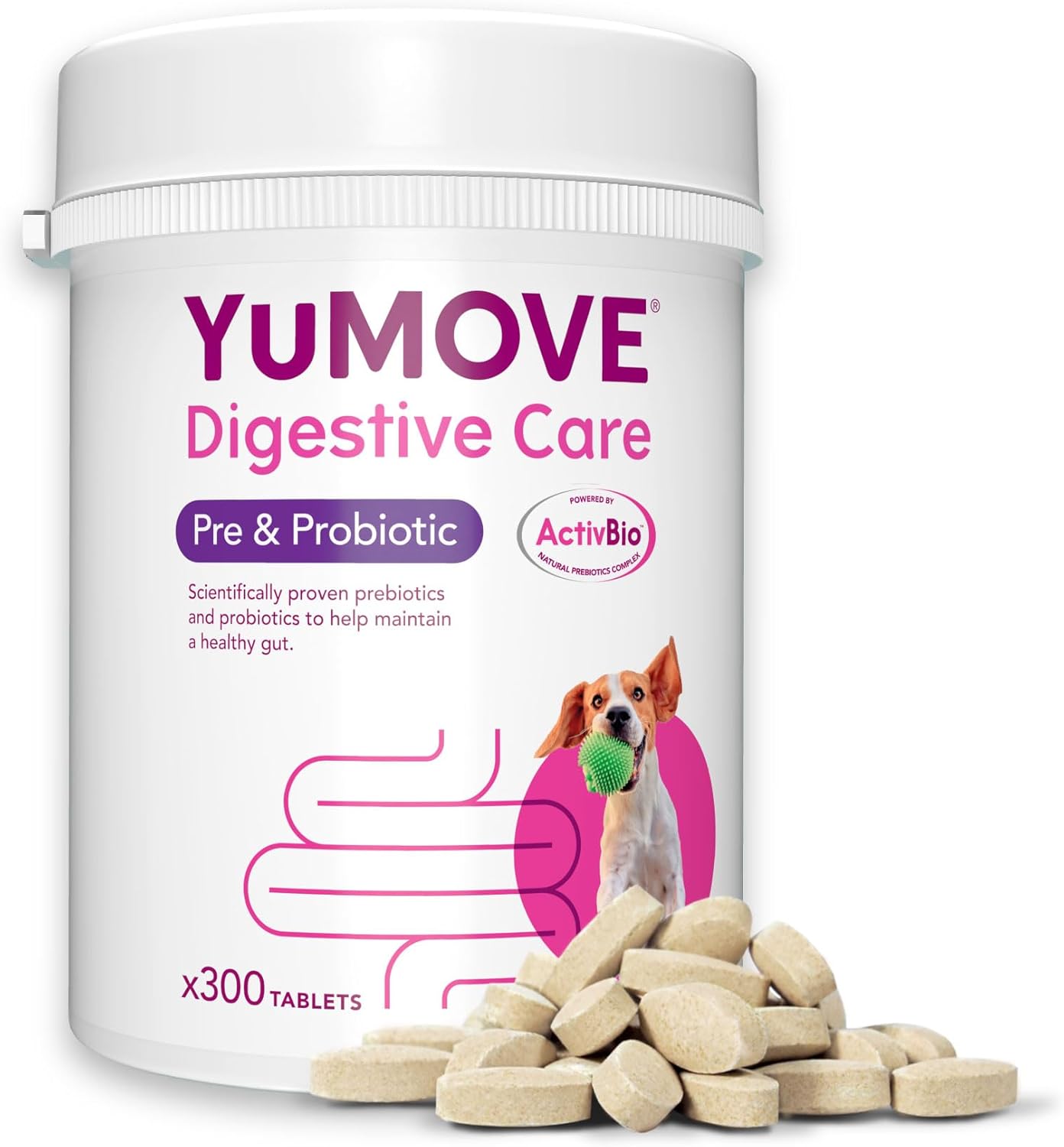
YuMOVE Digestive Care is a tablet. The listing says each one provides 200 million E. faecium plus a prebiotic complex, and the directions step up by weight: one tablet for dogs up to 10kg, two for 11 to 25kg, three for 26 to 40kg and four above that. A dog that eats tablets from your hand or in a bit of food will find it easy. A dog that spits them out will not.
Pooch & Mutt Bionic Biotic is a powder you sprinkle over meals. The listing describes it as suitable from 12 weeks of age and chicken-free. It is also a mixed product: the ingredients include maize, yeast and fish oil alongside the bacteria and chicory root, so it is not a pure probiotic and may not suit a dog with sensitivities to those ingredients.
Protexin Pro-Kolin Advanced is a liver-flavoured paste in a syringe. Its listing leans towards loose stools: it names psyllium, kaolin and montmorillonite as ingredients intended to firm things up, and says it can be given up to three times daily. That makes it more of a short-term digestive-upset product than a daily maintenance one. The listing also notes that it may contain soy. If you want the powder-versus-paste argument in full, see our comparison of probiotic formats.
Realistic expectations
A label that says "probiotic" does not tell you whether the strain inside does what you hope. Different bacteria do different things, and the research on dogs is thinner than the marketing suggests. If you want the vocabulary straight before you buy, probiotics versus prebiotics is a good place to start.
In practical terms, many owners give a product for the length of time on the pack and judge by the stools and the dog's general behaviour. If nothing has changed by the end of that period, stopping is a perfectly reasonable response. Increasing the amount beyond the directions is not.
Easy errors to make
- Changing two things at once. New food plus a new supplement means you cannot tell which one helped or hurt.
- Using human products. Some human supplements and flavoured yoghurts contain ingredients that are unsuitable for dogs, including sweeteners. Stick to products made for dogs.
- Guessing the amount. Use the directions on the pack for your dog's weight.
- Treating the supplement as the diagnosis. If the same upset keeps returning, something is causing it, and that is a conversation for the vet.
When to skip the supplement and call the vet
Ring your vet if diarrhoea lasts more than a day or two, or sooner for puppies, very small dogs and older dogs. Call promptly if you see blood or black stools, repeated vomiting, lethargy, a swollen or painful belly, or a dog that won't eat or drink. Any dog with an existing health condition should have the vet's agreement before a new supplement. This article is general information, not veterinary advice.
Products in this article


Affiliate links — we may earn a small commission at no extra cost to you.